

Table of Contents:
- Introduction
- Summary of Microsoft Dynamics 365 ERP Solutions.
- Major Advantages to the Contemporary Businesses.
- Use Cases / Who It’s Best For
- Feature Highlights
- Comparison of the other ERP systems.
- Why Choose Lannet?
- Conclusion
- Frequently Ask Questions
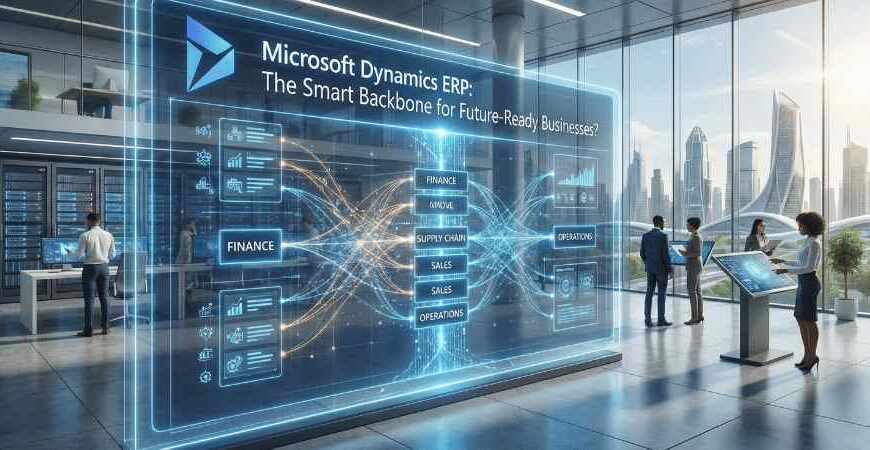
Expansion without assimilation is irritating. Data lives in silos. Reporting becomes manual. Decisions slow down. Microsoft Dynamics ERP, which is a subset of the wider Microsoft Dynamics 365 ERP, provides structural precision in such an environment.
Microsoft Dynamics ERP is a cloud-based enterprise resource planning platform, which is used to integrate financial management, the supply chain, project management, and analytics into one ecosystem. It allows companies to centralize information, automate the work processes, and create real-time insights.
Features:
- 1 unified ERP platform
- 360° operational visibility
- Financial reporting in real-time.
- Expansible cloud infrastructure.
The integration and intelligence are nowadays not an option when it comes to enterprises navigating through digital transformation. They are foundational.
Summary of Microsoft Dynamics 365 ERP Solutions.
Microsoft Dynamics 365 ERP is built in modules. The more complex an organization gets, the more capabilities it adopts and grows.
Core applications include:
- Dynamic 365 Business Central—Made to meet SMEs that need finance, inventory, and operation control.
- Dynamics 365 Finance—Classical financial consolidation, compliance, and worldwide reporting.
- Dynamics 365 Supply Chain Management—Supply chain management, procurement, logistics, and warehouse optimization.
- Dynamics 365 Project Operations – resource, budget, and profitability of the project.
This loosely coupled design minimizes implementation risk. The companies may begin with financial management and move slowly on to manufacturing, CRM integration, or analytics.
Highlights:
- Multi-currency and multi-entity.
- Artificial intelligence predictive systems.
- Native Power BI analytics
- Enterprise security that is supported by Azure.
The architecture allows operation depth without compromising on usability.
Major Advantages to the Contemporary Businesses.
Flexibility & Scalability
The contemporary business is dynamic. Adjustments have to be made to systems without restructuring.
Microsoft dynamics enterprise resource planning is a supporter of:
Elasticity of the cloud, without scaling the infrastructure.
- Custom workflow automation
- Industry-specific configurations
- Modular licensing
The organizations that enter new markets or introduce subsidiaries are able to increase scaling without altering their ERP base.
Microsoft Ecosystem integration
Microsoft Dynamics 365 ERP has the strength of integration.
It connects seamlessly with:
- Microsoft 365 (Excel, outlook, teams).
- Power BI for analytics
- Automation automation platform.
- Azure cloud services
Finance teams are able to work with live ERP data in Excel. KPIs are monitored by embedded dashboards by the executives. There is an enhancement in cross-functional collaboration due to the same language in systems.
Highlights:
- Unified data layer
- In-built business intelligence.
- Live excel connectivity.
- Autonomous cross-platform processes.
This eliminates manual reporting and duplication of operations.
Live Chat Insights and Analytics.
Data delays create risk. With Microsoft Dynamics ERP, there is no latency by using integrated analytics.
Capabilities include:
- Future cash flow prediction.
- Financial consolidation automation.
- Planning demand and inventory optimization.
- Leadership team KPI dashboards.
Real-time understanding enhances the governance and precision in the budget as well as the control of operations.
Use Cases / Who It’s Best For
Microsoft Dynamics ERP is used in various industries and enterprises of different sizes.
It has been specifically found helpful in:
- Ability to control manufacturing cycles by companies.
- The distribution companies with complicated logistics.
- Retail companies that strike the balance between stock and market demand.
- Organizations that are service-oriented and need to monitor the profitability of projects.
- Multinational companies dealing with compliance on a global level.
ERP modernization has quantifiable value to businesses that are growing, have disorganized operations, or are poorly reporting.
Highlights:
- Appropriate for both big and small businesses.
- Enforces international regulations.
- Allows centralized control and decentralized operations.
Feature Highlights
Financial Management
ERP value consists of strong financial management.
Microsoft Dynamics ERP provides:
- General ledger and consolidation.
- Forecasting and budgeting programs.
- Tax compliance automation
- Cash flow monitoring
- Ready to audit financial reporting.
These capabilities enhance compliance risk reduction and financial transparency.
Supply Chain
Volatility in the supply chain requires accuracy.
Key capabilities include:
- Procurement automation
- Inventory optimization
- Warehouse management
- Production scheduling
- Demand forecasting
Organizations minimize wastage of stock, reduce shortages, and enhance the delivery schedule.
Project Operations
In service-oriented businesses, margin management is very important.
Microsoft Dynamics ERP supports:
- Project budgeting
- Resource allocation
- Time and expense tracking
- Automated revenue recognition and bills.
This will guarantee the discipline in operations and profitability.
Customer Engagement
Microsoft dynamics is ERP centric but has the capability of integrating CRM to manage the customer lifecycle better.
Benefits include:
- Single sales and finance information.
- Contract management
- Service request tracking
The integration brings the generation of revenue and financial reporting on the same page.
Comparison of the other ERP systems
| Evaluation Criteria | Microsoft Dynamics ERP | SAP ERP | Oracle NetSuite | Odoo |
| Deployment Model | Cloud-first, hybrid | On-prem + cloud | Cloud-native | Cloud/Open-source |
| SME Suitability | Strong | Limited | Moderate | Strong |
| Enterprise Financial Depth | High | Very High | High | Moderate |
| Ecosystem Integration | Deep Microsoft stack | Limited | Moderate | Community-based |
| Customization Flexibility | High | High but complex | Moderate | High |
| Implementation Complexity | Moderate | High | Moderate | Low–Moderate |
| Built-in Analytics | Native Power BI | Add-on required | Built-in | Limited native |
| Global Compliance | Strong | Strong | Strong | Varies |
| User Experience | Familiar Microsoft UI | Technical | Modern cloud UI | Simple UI |
Microsoft Dynamics ERP strikes a balance between the functionality and the usability of the enterprise and the integration efficiency.
Why Choose Lannet?
Implementation expertise means success in technology. Lannet has organized ERP Systems Solutions, which are operational realities.
Highlights:
- 899+ Happy Clients
- 12+ Years of Experience
- 750+ Successful Deliveries
- 39+ Specialized Team Members
Lannet has modules such as
- Material Requirement Planning (MRP)
- Sales and Purchase Management.
- Inventory and Production Management.
- Payroll and Financial Modules.
- Quality Management
- WhatsApp and API integration.
- Dynamic dashboards
Introduction is done in a disciplined manner:
- Business analysis
- ERP planning and choice of module.
- Configuration and customization.
- Employee training and testing.
- Continuous support deployment.
This would reduce the risk of disruption and maximize the amount of money spent.
Conclusion
The Microsoft Dynamics ERP is more of a strategic infrastructure choice, but not a software upgrade. It consolidates operations, advances financial control and real-time analytics, and facilitates scalable expansion.
Microsoft Dynamics 365 ERP will be a versatile and future-proof option for organizations that want to streamline operations, automatize processes, and achieve objective control over operational data. With proper implementation, it forms the foundation of sustainable enterprise performance.
Frequently Ask Questions
Does Microsoft Dynamics ERP fit mid-sized companies?
Yes, definitely, with Dynamics 365 Business Central.
Is it facilitative of multi-country operations?
Yes, multi-currency and compliance.
Is it compatible with third-party tools?
Yes, using APIs and Microsoft power platform.
What is the duration of implementation of ERP?
Normally 3-9 months depending on complexity.
Why Lannet for ERP Systems Solutions?
Lannet is a synthesis of technical assistance, customization, and organized deployment assistance.

