

Table of Contents
- Can Modular ERP Truly Transform Businesses with Flexible, Scalable Systems?
- What Is Modular ERP and Why Is It Reshaping Modern Enterprises?
- Why Are Organizations Moving Away from Traditional ERP Systems?
- How Is Modular ERP Architected in Terms of Features and Capabilities?
- What Are the Core Differences Between Modular ERP and Traditional ERP Models?
- Which ERP Modules Enable Flexibility and Scalable Business Growth?
- How Does Modular ERP Support Phased and Agile Implementation?
- What Business Value and ROI Can Organizations Expect from Modular ERP?
- What Implementation Challenges Should Businesses Prepare For?
- How Does Modular ERP Enable Long-Term Scalability and Expansion?
- What Is the Future of Modular ERP in Cloud-First Enterprises?
- Conclusion: Is Modular ERP a Strategic Advantage for Growing Businesses?
- Frequently Asked Questions About Modular ERP Systems
What if the software your company needs were able to adapt in the same speed as your business, avoiding the need for disruption, expense, or rigidity?
This is a critical question that is leading to a major rethink on the whole area of ERP suitability. The old model was designed for stability, whilst the new model is designed for businesses that need flexibility, speed, and optimization. As a result, the concept of a modular approach to ERP emerged to address the technology landscape.
Highlights
The growth of the ERP market is fuelled by the emergence of cloud computing and modular adoption models.
- Phased ERP systems have lower failure rates than those in the one-phased system.
- The early days of ERP recovery are typically driven by a minority of central ERP functionality.
- Scalable ERP systems maximize system lifespan and decrease the total cost of ERP system ownership.
Such trends are indicative of the overall move towards flexible, composable enterprise systems.
What Is Modular ERP, and How Is It Transforming Modern Enterprises?
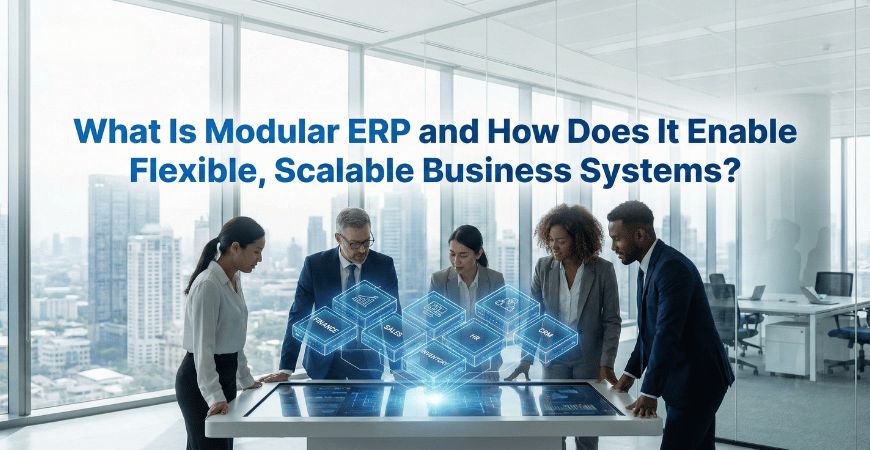
“Modular ERP is a term used to characterize a method of providing enterprise resource planning applications as functional or independent software modules instead of a single system.” Each module supports a particular functional or single business activity, such as finance, inventory, sales, purchasing, HR, or production, yet shares the single data infrastructure.
This change is all about the ability to choose what is used when the organization needs it, not requiring more or even correctly predicting future needs that an organization may or may not attain.
Why Are Businesses Moving Away from Traditional ERP Systems?
In the case of traditional ERP, the implementation practice generally tends to follow the “all or nothing” mentality, where companies commit to investing heavily during the initial phase of implementation and have to adopt a very long implementation cycle for deriving the results.
Common challenges are
- High capital investment cost, lack of ROI
- Rigid work processes needing significant
- Prolonged deployment times that delay the associated business benefits
- Limited Flexibility Once Systems Are Live
Modular ERP adopts this trend with incremental adoption and allows an organization to showcase value while guaranteeing long-term scalability.
How is modular ERP defined by its features and capabilities?
In general, the modular concept definition is characterized by a number of distinctive features regarding ERP systems:
- Independent modules can be individually replaced or upgraded.
- Centralized data architecture in order to ensure uniformity and accuracy.
- API-driven integrations for interoperability with other systems.
- Cloud-ready design to enable scaling and remote access
This structure supports continuous improvement rather than one-time transformation, making ERP an evolving platform rather than a static system.
What are the Main Differences between Modular ERP and Traditional ERP?
This is a considerable difference, which explains the popularity of modular ERP systems.
| Dimension | Modular ERP | Traditional ERP |
| Deployment Model | Incremental and phased | Single large rollout |
| Cost Structure | Spread over time | High upfront investment |
| Flexibility | High, module-based | Limited after deployment |
| Customization Scope | Targeted by module | System-wide complexity |
| Time to Value | Faster early returns | Delayed ROI |
| Scalability | On-demand | Structurally constrained |
Which ERP Modules Drive Flexible & Scalable Growth?
Generally speaking, an organization’s introduction to the overall notion of ERP in a modular way tends to come in a small, core group of primary modules, thus affording a rapid stability to an organization.
The common starting points include:
- Financial Management: accounting, budget, compliance, etc.
- Inventory Management: stock visibility, demand alignment
- Sales & Order Management: in revenue operations
- Procurement Management: vendor coordination and cost control
After these main modules are defined, the focus of the business is on production planning, payroll, quality, and analytics.
How Does Modular ERP Enable Phased or Agile Approaches?
Modular ERP enables an implementation strategy that allows for progression rather than disruption.
A typical three-stage approach involves:
- Business process evaluation and module selection
- Initial deployment of core financial or inventory modules
- Gradual expansion in areas such as sales, procurement, or operations
- Optimization through reporting and dashboards, and automation
Such an arrangement is also protective of risk, facilitates the use of the system, and enables teams to transition easily to changes.
What Are the Business Benefits and ROI of Modular ERP?
Modular ERP benefits from an enhanced ROI, where cost and uptake are aligned.
The key benefits here are:
- Reduced financial risk through phased expenditure
- Quick realization of operational improvements
- Better decisions through real-time visibility
- Reduced waste in unused features and licenses
This is because it creates quantifiable benefits, leading to increased executive confidence that justifies investment.
What Challenges Do Organizations Face with Modular ERP?
While it does have its own set of benefits, a planned approach is necessary when
Potential challenges include:
- Managing Data Consistency among Modules
- Building effective integration architectures
- Managing the integration of the change management activities throughout the
- Maintaining governance as the systems scale
Such risks are probably best tackled by robust implementation frameworks, ownership structures, and long-term ERP strategies.
How Does Modular ERP Support Scalability and Expansion?
As organizations expand, using modular ERP can:
- Addition of new modules without reimplementation
- New markets or business units
- Integration with specialized third-party tools
- Evolution in continuous systems without interruption
What Is the Future of Modular ERP in Cloud-First Enterprises?
Modular ERP naturally aligns with the future of ERP as it becomes even more “cloud native,” “composable,” and “service-oriented.” ERP in the future will likely be characterized
- Ensuring continuity of updates without downtime
- Rapid Innovation through Plug-and-Play Capabilities
- Integration with analytics, AI, and automation platforms
It appears, however, that existing ERP systems, instead of being replaced, are becoming platforms that adapt strategies.
Conclusion: Is Modular ERP a Strategic Advantage?
“Modular ERP is the hallmark of a paradigm shift from traditional ‘hard-wired’ enterprise computing to a much more fluid form of digital computing.” Moreover, “It enables businesses to transform at their own pace, make strategic technology investments with the utmost precision, and scale their businesses without disrupting
“For organizations that need long-term resilience, flexibility, and ROI, modular ERP is not an alternative; it’s the norm.”
Frequently Asked Questions
1. What is modular ERP?
It shall be an ERP system consisting of separate modules that could be implemented gradually.
2. What is the difference between Modular ERP Systems and conventional ERP Systems?
It enables phased adoption instead of a single adoption process.
3. Is Modular ERP Affordable?
Yes, businesses only have to pay for the actual modules used.
4. Does Modular ERP System Scalability Match Business Growth?
Yes, new modules can be added. There is no need for the existing system to be replaced.
5. Can large companies utilize Modular ERP?
Yes, it does support complicated operations and long-term expansion.

